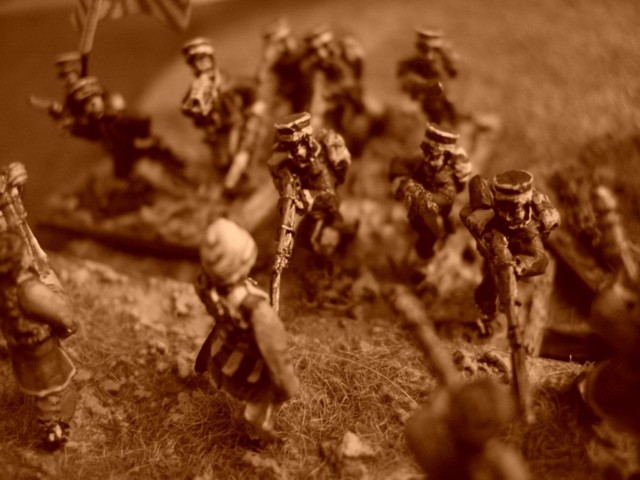
BATTLE OF THE RIVER CHI, Korea, August 1894
This is a non-historical battle that I fought solo. Terrain was generated using the POW system, and I used variable strengths (battalion strength is known only when it first shoots / tests).
In the countryside around Seoul, elements of a Japanese landing force, striking inland, have encountered a large force of Chinese. A slow-running river, of unknown difficulty, separates the protagonists. It is knowingly fordable at only one point, just north of a farmstead. The Japanese commander intends to seize this ford and await reinforcements.
Victory conditions
The POW system generated two objectives : the ford, and a hill near the eastern edge of the table.
The Japanese player allocated 60pts to the ford, 20pts to the hill and 10pts to the Chinese supply centre where the road leaves the southern edge of the map. The Chinese allocated 30pts to the ford and 50pts to the hill.
The battlefield
Following the POW system, the only terrain difficulty known in advance to both sides was that of the three hills on the battlefield, there being no terrain in either side's deployment area. Other terrai difficulties were discovered as the game went along, but all are noted on the initial map.
The biggest surprise was the river. It turned out to be unfordable to any troops along the majority of its length, excepting a 30cm (600yd) stretch on the west wing of the engagement. The woods was also very dense, open only to infantry with no group movement allowed, which pretty much rendered it useless to the Chinese player and got in the way of his cavalry.
Deployment
Following the typical order of play for an encounter battle (see my section on POW), both sides changed their command structure within normal parameters, the Chinese set up their units (on movement bases), and then the Japanese set up their units (directly) on the table edge. Both sides then wrote their orders.
The Japanese profit from a highly flexible command structure, which allows them to adapt to the circumstances of the battle. The C-in-C detached three infantry battalions under his own command, the 1st Brigade was allocated four infantry battalions (including a battalion of native Korean auxiliaries), and the 2nd Brigade was, in an unusual (and rather unfruitful) manoeuvre, given the cavalry and the artillery.
In classic manner, the Chinese C-in-C brought the Imperial Guard (three FF,nbl) battalions under his orders, and detached both artillery batteries to the better infantry brigade, who was to be his hammer (though it didn't quite work out that way...). The Chinese massed in the centre, with the C-in-C holding the reserve behind the woods (that he did not yet know was nigh on impassable, infantry on irregular movement bases counting as artillery in difficult terrain). The 2nd Brigade was detailed to hold the left flank. In response, the Japanese deployed across the full width of the table.

The Chinese plan was to engage heavily in the centre, making full use of extra numbers to detach flanking forces. The cavalry brigade was to strike into the plain between the Chi River and the eastern hill, to avoid Japanese reinforcements moving to or from the hill. Given the troops deployed opposite them, the 2nd Brigade received orders to advance with brio, in an attempt to reach the river bank before the Japanese. The dummy movement base was deployed on the far right, to simulate an attack on the hill.

The C-in-Cs command was to be the pivot of the Japanese plan. The three battalions were intended not only to hold the ford, but to deploy in such a fashion as to command a large field of fire, which they were to do with success. The 1st Brigade were to advance as quickly as possible to the river. Although the enemy forces opposite them were of unknown strength (as hidden on a movement base), there was only one base and it seemed probable that the Japanese could carry the day. They were therefore given orders to slowly cross the river and, after destroying opposing forces, to swing to their left and crush any Chinese attempt to take the ford in a pincer movement. The combined cavalry-artillery brigade, facing totally unknown odds, was simply to hold the area between the eastern hill and the river, where it would be supported by at least one battalion of the C-in-Cs command.
With everything set, the battle began.
Turns 1-2 : the western flank
The Japanese got off to a sultry start, and the Chinese 2nd Brigade managed to reach the riverbank before them - only to discover that much of it was unfordable. This worked to the Japanese advantage, as it allowed them to advance and profit from the cover of the opposite bank. Unfortunately for the Chinese their militia units - more use in a charge than in a firefight - were on the wrong side of the brigade and had to cross behind it in order to reach the fordable zone. This took a lot of time, and was not completed before a Japanese battalion had gotten across the river.
Turns 1-2 : the Centre
The Chinese advance was held up by the orchards and fields, which proved to be unusually dense, reducing infantry movement to speed 2. The Japanese C-in-C had deployed his troops rapidly, and the Jap breech-loaders (remember, we are in 1894, not 1900) began to inflict casualties. The nbl-equipped troops of the 1st Brigade were ready to fight (average rolls for start strength), but brittle (a lot of failed morale tests !).
Turns 1-2 : the eastern flank
With three Chinese movement bases still unrevealed (those of the C-in-Cs and 3rd Brigades, and the dummy), the Japanese were uncertain what might be waiting for them. They therefore remained static, deploying their artillery, and allowing the Chinese cavalry to deploy in leisurely fashion opposite them.
Turns 3-4
Turn 3 was fairly uneventful. In the west, the Japanese battalion finished crossing the river and lined up on the Chinese flank, causing some consternation. In the east, a long and exhausting cavalry battle begun, which would see the two protagonists reduced to exhaustion. By turn 4, the Japanese cavalry was getting the worst of it, with their accompanying artillery unable to get in a shot worth speaking of against the mobile Mandchou horse archers.
During turn 4, however, the Chinese C-in-C, noting that his troops were having a hard time in the centre, ordered the 1st Brigade to Attack towards the river and relieve the pressure on the right flank of the 2nd Brigade. This was to prove an excellent choice, despite the flanking fire that the advancing troops would take from the Japanese C-in-C.
Turn 5
On the eastern part of the battlefield, things are looking grim for the Japanese. If the cavalry of both sides is in tatters, the nomad horse have nonetheless managed to charge the Japanese artillery in the flank.
The Japanese centre is holding firm. The Chinese 3rd Brigade has revealed itself to be but a handful of militia units, from whom the C-in-Cs troops in the rough ground beyond the river risk little. The Japanese right is looking less certain. The battalion deployed beyond the river now has its flanks menaced by a horde of Chinese - one of whom, a unit of militia, rolled a start strength of 14 ! The Japanese here are also taking artillery fire from a battery that has been (slowly, slowly...) brought up in support.
Turn 6
The Japanese artillery is in disarray, one battery having retired shaken, the other forced, to protect its flank, to turn on the nomad horsemen who are scarcely the most essential target on the battlefield. The cavalry of both sides are by now out of service, the best unit among them being at strength 4. The Japanese battalion defending the rough terrain in the centre-east chooses to withdraw to avoid being charged, which turns out to be a mistake (as it renders them incapable of firing on the advancing Chinese for several turns), though not a crucial one.
In the west, the battle has really heated up. Losses are heavy enough that units are better off charging than taking fire and risking morale tests, and men fix bayonets and plunge into the sluggish water. In the centre, the Chinese have managed to advance to the farmstead, but pose little threat to the defenders of the ford.
Turn 7
The Chinese militiamen on the western flank of the battle turn out to be of very poor quality indeed (incredibly, all three units are at a starting strength of 5, which requires 3 rolls of '1' on a D10...). This is of great help to the Japanese, who are really getting the worst of it here. The Korean auxiliaries, having charged across the river, are taken in the flank, and a Japanese battalion thrown back by enemy fire.
Turn 8
With the cavalry battle petering out, the Japanese can finally turn their artillery on the Chinese 3rd Brigade. The centre holds as steady as a rock; but the Japanese 1st Brigade has caved in and the Chinese can begin to cross the river.
With the plains to the east now empty, and the Japanese beyond all hope of sending reinforcements to the hill, due to the weakening but still present 3rd Brigade, the Chinese C-in-C leads the Imperial Guard, majestically, to take the objective, arriving there by forced march on the 10th turn. In this respect, the Chinese plan has worked very well indeed, and the decision to not reinforce the centre with the C-in-Cs brigade has paid off.
Turns 9 and 10
The game ends on turn 10, with the first Chinese forces having crossed the river, delayed by the last survivors of the Japanese right. The hill is firmly in the hands of the Imperial Guard.
Victory
The Chinese have 61% of their starting strength remaining (+61 pts). They have captured the hill (+50pts) but the ford is in enemy hands (-30pts). Total : 71
The Japanese have only 44% of their starting strength left (+44). They firmly control the ford (+60) but have lost the hill (-20). They failed to damage the Chinese supply lines, an over-ambitious objective which costs them -10. Total : 74
The battle is thus a draw (I consider that a 20% difference is needed for a victory).
Casualties
The Japanese C-in-C lost only 5 of the 39 strength points he commanded. The 1st Brigade lost a massive 39 out of 49. The 2nd Brigade lost 22 out of 33, mostly cavalry.
The Chinese 2nd Brigade was, as might be expected, badly mauled and to boot had a weak initial force. They lost 43 out of 56 (normally, this brigade would have 70) strength. The cavalry losses were near-total, with three regiments out of four evaporated, and only 3 out of 31 strength points left in action. Elsewhere, Chinese losses were relatively light. The 1st Brigade took only 24 out of 91, despite having made but little headway in the centre, and the 3rd Brigade only 9 out of 38, due to the time taken for the Japanese artillery to swing into action.
If I could turn back time...
Grouping the artillery with the cavalry to create a mobile and hard-hitting force for the Japs was a good idea, but not against enemy cavalry. The artillery spent most of the game changing its fire arc to get a shot or to protect itself against a charge.
Other than that, things seem to have worked well. I didn't succomb to my usual impetuous need to make the Chinese charge rather than fire, and they consequently dished out serious casualties on the Japanese right flank. Having the Chinese C-in-C detached from the battle is a must, as it allows the all-important orders changes (well, change) that helps the Chinese use their advantage in numbers.
Things are, however, made easier on the Chinese in 1894-1895 since their opponents do not yet have the deadly repeating rifles.
On the Japanese side, the essential is not to panic before the sheer numbers of Chinese coming towards you. I was tempted to change Jap orders on several occasions in the centre, but it is just as well that I did not. The one battalion that withdrew from its position to avoid being charged ended up in the same situation tw turns later, having lost its fire in the meantime.
I think that, in general, the Japanese need to manoeuvre quickly and efficiently into position - profiting from the fact they have the first move to do this - and then simply stand and pour fire into the oncoming enemy. As few units as possible should be tarting about. Cavalry could better fill this role. Next time out, I will use the three officers to form three infantry brigades, and attach the cavalry regiments directly to them rather than considering them as an independent formation...